The Surprising Way iReady Data Can Transform Student Outcomes
With everything I have to deal with as a special education teacher, why in the world would I ever focus on a student's vocabulary. The answer is quite simple. It impacts EVERYTHING!!!
What does this have to do with planning? Planning for students to make IEP goals is ALL based on data. Read on to see how I start planning for my OG groups by answering the larger questions about what in the world is up with my student's vocabulary scores? Is there anything I can do to increase their vocabulary?
I spend the bulk of my teaching time (like everyone else) on phonemic awareness and phonics with a side of fluency and comprehension.
Yes, vocabulary is built into each listen but is it enough???
I would hazard a guess for this group of students, this project is focusing on, it's not even close to helping them close gaps.
Five facts that prove why this is important
- Improved Communication Skills: A strong vocabulary enables students to express themselves clearly and effectively, helping them articulate their thoughts, ideas, and emotions with confidence. It allows them to engage in meaningful conversations, express their needs and opinions, and actively participate in classroom discussions.
- Reading and Comprehension: As students encounter new words in texts, a rich vocabulary enables them to decipher the meaning of unfamiliar words and understand the overall context. The more words students are familiar with, the better equipped they are to comprehend and enjoy a wide range of written material, expanding their horizons and fostering a love for reading.
- Academic Success: Many subjects, such as language arts, social studies, and science, require students to understand and use specific vocabulary terms. By expanding their vocabulary, elementary students can better understand textbook content, and comprehend instructions. A broad vocabulary also contributes to better writing skills, allowing students to express their ideas fluently and effectively in assignments and essays.
- Critical Thinking and Problem Solving: A diverse vocabulary enhances critical thinking and problem-solving abilities. Vocabulary development fosters cognitive flexibility, enabling students to analyze problems, make connections, and draw conclusions based on the information available to them.
- Increased Confidence and Self-esteem: Building a strong vocabulary instills confidence and boosts self-esteem in elementary students. When children possess a rich vocabulary, they feel more assured in their ability to express themselves and engage in social interactions. They become more comfortable speaking in front of others, advocating for themselves, and participating actively in group activities. This confidence extends beyond the classroom and positively impacts their overall personality development and social interactions.
Science of Reading and Vocabulary
The Science of Reading model recognizes the intricate connection between students' vocabulary and reading development. Vocabulary is a fundamental component of reading comprehension, as understanding the meaning of words is crucial for understanding written text.
In the Science of Reading model, vocabulary instruction is seen as an essential part of teaching reading skills. By explicitly teaching students the meanings of words, word relationships, and word-learning strategies, educators can equip them with the tools necessary to decode unfamiliar words and make connections between words and their meanings.
A strong vocabulary enhances students' ability to comprehend and analyze texts, make inferences, and engage in critical thinking. Furthermore, vocabulary instruction in the Science of Reading model goes beyond isolated word memorization; it focuses on teaching words in context, promoting a deeper understanding of how words are used and their nuances.
Science of Reading, Vocabulary, and Special Education
I have witnessed firsthand how the Science of Reading model of reading and a weak vocabulary can significantly impact students. For students with learning disabilities or language delays, the lack of a solid vocabulary foundation poses immense challenges in their reading journey.
Without a strong vocabulary, students struggle to comprehend texts, decode unfamiliar words, and make meaningful connections between words and their meanings. This weak vocabulary hinders their ability to access grade-level content, understand instructions, and participate fully in classroom activities.
It also affects students' overall confidence and self-esteem, as they may feel frustrated and left behind compared to their peers. As a special education teacher, I recognize the critical importance of addressing vocabulary deficits through explicit instruction, targeted interventions, and multisensory approaches.
By incorporating evidence-based strategies from the Science of Reading model, such as word-learning techniques and vocabulary-building exercises, we can help these students develop a robust vocabulary, overcome reading challenges, and unlock their full potential for academic success.
Which Cliff did I jump off First?

But before I jump head-first into setting this idea up … a reality check about why is iReady even a part of my thinking as a Special Education teacher.
How my building and I use iReady:
- It’s dictated by my state and building to use it. Classroom teachers do use the benchmark scores for their yearly professional evaluations as part of their ratings. Most offend beginning of the year to mid-year.
- Teachers do (yet frowned upon & 🙄) use either the Benchmark, Category, or Growth Monitoring score for Read Plans.
- Read Plan cut-scores come from iReady Scaled Scores (students who need to be placed on a Read Plan K-3)
- Our building RTI/MTSS team, lets teachers use the same Read Plan goals for RTI/MTSS goals to help with the workload.
- iReady as a whole is only as good as the student taking it meaning it reflects how a student feels about testing.
- iReady aligns with state standards.
- Specialists and administration look at most of the data from a balcony view, so the whole grade or a whole population of students.
- iReady will pull out program strengths and needs. But it takes time with both a program and using iReady to ensure you have a solid picture to make decisions about.
- Building Interventists use iReady Benchmark to create groups to pull for both reading and math.
A few cons to using iReady Benchmark scores, category, or Growth Monitoring Scores to make decisions.
- iReady Reading will pull out a program’s and grade levels strengths and needs–aka the good, the bad, and the ugly. (ask the question be prepared for the answer even if you don’t like it) & in my case falls way outside of my purview but it has come up in student-specific conversations. (which is toad-ally fun)
- To the best of my knowledge, the Benchmark Data (whole and category-scaled scores) are the only thing that you can do something with on a macro scale. An example: "By iReady mid-years, and given small group phonics instruction, Joey will be able to increase his iReady phonics score from 350 to 400 scaled points."
- As I mentioned in the previous paragraph, if a student’s not feeling it how accurate is it??? Hence the need for a body of evidence when you start talking about needing additional interventions, need to make a course change, or looking at special education testing.
- Using the data from Growth Monitorings is a no-go. The Growth Monitor is designed to be a “dipstick” of how things are going. It’s short and to the point. It doesn’t test across all five domains every time you give it. This means you have a high probability of getting false data. Couple that with making intervention decisions off of and well … off the cliff we go. It also takes at least 4 data points to get a student-specific trend line.
I cannot change how my building uses iReady for intervention progress monitoring. I can only change the progress monitoring tool when the students are brought for me to review or a teacher comes to me with a question about what tool to use.
Teachers and Parents: If you use or see iReady Progress Monitoring for Read Plans or for RTI/MTSS goals, ask yourself, “Is this progress monitoring tool going to give me the information I need to make instructional decisions?” “Is it specific enough to tell me if the student has mastered the skill or not?”
Do Not use it if you don’t have to create goals and as a progress monitoring tool.
What do I do with iReady Data as a Special Education teacher?
I use iReady as a special education teacher as part of their body of evidence. It is part of their whole data story. It is part of the WHOLE STUDENT and is never used as the end-all-be-all of a student.
Why????
Depending on which data set you are looking at within iReady you can only gleam specific information or thoughts around a student or Core instruction.
In my building, the hope is that if the student is in any interventions, you can see it translate back to moving Benchmark scores aka the Student's Annual or Stretch growth. (this also requires additional data not just these data points)
This means iReady should not replace intervention-specific data collection–the mirco data you are collecting on if the intervention is working. iReady will give you notions of carryover.
iReady is the macro the big picture. In my building, iReady is a pretty good predictor of how 3rd-6th grade students will perform on the State Assessment in April. (Yes, this means Spring Benchmark is given after students take the State Assessment. And, yes, I can only speak for my state and building. And our state-reported data has held this idea to be true the last four years–even though COVID–both good and bad.)
Back to how I use this information as part of my data collection for students who see me for reading or math.
- The Fall benchmark is where I look at where my students scored the lowest and the highest. This gives me a gauge as to how students are coming back to school after having 10 weeks off. These scores tend to align with IEP goals and end-of-year progress monitoring data. Such as the Phonics "can dos" matching the CORE phonics survey data.
- Benchmark to Benchmark data look at the percentages it can tell you if students dropped. I use the percentage data more than the Scaled Scores. (If you can always print out the benchmark data.)
- I look at the Can Dos to gain insight into skill breakdowns. These can give ideas as to the next steps and may or may not align with IEP goals. The insights here help me more with math than reading.
- I pull the Diagnostic results for all the grades aka the ultimate balcony view. This is a must for my LD reports and any intervention questions I get. I pull grade-level Scaled Score averages after each Benchmark. I have to report how the student compares to their grade level peers.
- From an RTI/MTSS perspective, the Diagnostic Report, allows you to break down the data to understand if you have a strong core in reading or math and set building or grade-level goals to move students across bands.
- My state and building/district mandate classroom teachers give the Reading growth monitor each month for Read Plan students. It takes at least four data points to get anything useful from the information. (See #7 for more)
- I can assign the Math Growth Monitor. I have in the past given this as part of the monthly progress monitoring data I collect. Like with Reading it takes time to get anything one could call useful and most certainly nothing I would ever set goals using. If, and I do mine if, the student took the assessment seriously I can see if both Core and intervention as working or if they were messing around on a Diagnostic. (like that never happens)
- I can ONLY usefully use the Benchmark numbers to make instructional decisions. This means I can compare Fall to Winter; Winter to Spring; and Fall to Spring. The data from Winter in my building historically, is not reliable as most students drop. (Some a little. Some a lot. That’s a whole different rant for a different time. lol.)
I did promise the good, the bad, and the ugly. This is how we use iReady. Is it the only way, probability not. Are there other reports, things to glime, or things not to do, most likely but this is what I'm going with.
Stay tuned for how I plan to attack this for the coming school year and learn some nuggets that you can take back and use in the fall to build student vocabulary that are research-backed and align with the Science of Reading.

Why Unlocking Vocabulary is Key to Bridging the Gap for Students
The hard thing about waiting three months for iReady's classroom diagnostic data is not knowing how students will do after 10 weeks of intervention.
My state and building use iReady diagnostics three times a year for READ Plans and intervention data. (more on come on iReady-both loves and dislikes)
As a special education teacher, I only use this data to compare students to their peer group and see what kind of gains they had over the year. (I have a whole blog post coming on how my building uses iReady.)
My building relies on this information to make predictions about State testing outcomes and interventions.
For me, I look at the overall gains my students make on the five categories assessed each time. This year, I made a huge shift to building and creating a solid foundation in phonemic awareness and phonics.
The macro data showed students made huge gains when using both Heggerty and Yoshimoto Orton-Gillingham. We lived in controlled decodable and built vocabulary through morphology.
What didn’t improve???
Student’s vocabulary
On iReady, students’ scores either dropped or maintained.
I’m the first to tell you that you should never, ever make significant instructional decisions on a single piece of data. It could take you off a cliff.
But if you layer in IEP goal data and it shows everyone either made or is on target to meet their goals well within their IEP cycle …
Could layering in something, not a change continue that growth????
Could it support and build students’ vocabulary and not have all the growth drop off???
Why Focus on Vocabulary
When I explain the five reading components to parents, I use a pyramid. Phonemic awareness and phonics are the base of the pyramid. With vocabulary and comprehension coming after. Fluency is needed across all.

But what happens when you have weak word-level vocabulary????
What then? Let me explain how I landed here ...
All my phonics kiddos were placed in Orton-Gillingham. As the year progressed, the pacing of these groups slowed. In some cases stopping for a week or so on a concept, or phonogram or just working to get them unconfused. (English is so confusing.)
As lessons got more complex and the more layers students had to work with the more, I noticed other holes. Looking back at my lesson notes and comments about student progress within lessons it became more obvious that vocabulary was one thing students were struggling with.
To be clear, I'm not talking about Tier 3 subject-specific words. I'm talking about Tier 1 words--like chair, boil, broil, etc. (here is my previous post on Vocabulary Tiers)
Yes, about half of those I pull for OG do receive pull-out language support from a Speech-Language Pathologist.
The funny (or head-banging) thing about all their iReady Vocabulary score was the “can dos” all said to teach 5 words and all through read-aloud. (This is a great idea for classroom teachers; not so much for specialists.)
What Does the Research Say
The Science of Reading (SoR) is an evidence-based approach to teaching reading that is grounded in research from cognitive psychology, linguistics, and neuroscience. It emphasizes the importance of systematically teaching foundational skills to help students become proficient readers. One crucial aspect is phonemic awareness, which involves recognizing and manipulating individual sounds in spoken words.
By explicitly teaching students to understand the connection between letters and sounds through phonics instruction, they can decode words and read fluently. It's essential to provide activities that engage students in segmenting, blending, and manipulating sounds in words to strengthen their phonemic awareness and phonics skills.
Phonemic awareness refers to the ability to identify and manipulate individual sounds in spoken words. It is a critical skill that helps students understand the connection between letters and sounds. Phonics instruction teaches students the relationship between letters and sounds, enabling them to decode words and read fluently. Teachers should provide explicit instruction in these skills, using activities that involve segmenting, blending, and manipulating sounds in words.

Comprehension involves understanding and making meaning from text. Teachers can support comprehension by explicitly teaching strategies such as predicting, questioning, summarizing, and making connections. These strategies help students engage with the text, monitor their understanding, and make inferences. It is also essential to promote metacognition, encouraging students to think about their thinking and monitor their comprehension. By incorporating these strategies into instruction, teachers can help students become active and proficient readers.
What Does this Mean
SoR and Scarborough's Rope Model of Reading bring a new light to an old question surrounding phonics and vocabulary. The question is how to layer something in that doesn’t take away from the gains students have made.
I don’t know why this group of students have a weak vocabulary. I could blame COVID–these students were remote and hybrid during COVID. It could be the lack of direct, explicit instruction surrounding Tier 1 and Tier 2 vocabulary. Or it could be the lack of helping students make connections to previously taught vocabulary to new words.
Coming this semester, I’ll share how I plan to attack this and build students’ Tier 1 and Tier 2 vocabulary. I hope to find actionable, tangible ways for students to make gains that don’t take tons of time to get the most bang for my buck as a special education teacher all while doing my job as their special education teacher.
Chat soon-

What I use to help me make Data Driven Decisions
I was wrapping up my post-observation meeting with my principal and data came up. He asked, “How did I come to the decision to teach what I did?”
So, I pulled out a copy of my Assessment Data Analysis. I love LOVE using this form. {Catch the video to see how I fill it out and grab your own copy.}
The cool thing about this form is the power, control, and guidance it gives you over your data. It is also open-ended enough to use any pre-assessment you want. Well, within reason.
The data I used was from my Orton-Gillingham groups, their most recent pre-test from my Phonics Progress Monitoring. I assessed them using the Short Vowel Mixed Digraphs.

- Teacher Evaluations
- RTI/MTSS Body of Evidence
- Monitoring Progress of Intervention groups
- Mirco IEP Goal Progress
Assessment Data Analysis
This Data Analysis is perfect for RTI/MTSS interventions and Special Education groups or if you have to provide data as part of the teacher evaluation–like me. Bonus administrators love it as you have your thinking right there on paper.
I use this ALL the time. I keep it in each group's binder. This doesn't replace IEP goal progress monitoring but it gets me out of the weeds. I think most of us in Special Education we get caught up in the microdata a little too much and forget to come up for air.
This form allows me to see the group data from a balcony view. Just like my Phonic Progress Monitoring--I can break down where a student is struggling and differentiate my lesson to target more nonsense words or more sentence fluency work or more controlled contented text.
I love that I can catch any misconceptions right from the beginning and not later as I address vowel confusions.
This year part of my professional goal has been to find a way to track growth/mastery using Orton-Gillingham to make having grade-level skill carry-over conversations easier. I don't know about you but my classroom teachers they like to see the data before they make decisions. [I love this as this has been a HUGE RTI and intervention push!!]
I used my Phonics Progress Monitoring Tool.
.png)
A couple of important things about my Phonics Progress Monitoring tool
- Yes–I use an Orton-Gillingham scope & sequence to provide explicit phonics instruction to my student education goals but it’s TOTALLY OKAY if you don’t. It will still HELP you determine if students have mastered the phonics phonogram in question.
- It will work with ANY phonics scope and sequence--from Core to Special Education
- This product is bottomless and growing--grab your before it grows

How to Fill out the Assessment Data Analysis
This video will show you how I filled out the form using my Phonics Progress Monitoring Tool but it can be used with any assessment.
Pick an assessment that can be used as a pre-test or baseline and something that is short-lived. Like your next math unit on double-digit addition or subtraction, or next grammar unit or your next phonics unit. Unit quizzes work–just pull something towards the end of the unit or subject. This will help you establish a baseline on most if not all of the standard you will be teaching. (I try to keep mine to either a page or less than 10 questions.)
To use this form you don’t need to have multiple teachers using it.
Give the assessment and grade.
Establish and define Mastery. AKA: what’s that score that tells you the student’s “got it.” (Most of the time I go with 80% but it depends on the skill. For my phonics work, I establish mastery at 90%.) Write down whatever you decide. It will not change for this round.
Starting on the Pre-Assessment side: fill out the date, Unit and Standard(s), Length of the unit (I have found making this less than 5 days sets everyone up.), and Big Ideas.
Moving down the form: add teacher(s) name, the total number of students who took the assessment, the number and percent of students proficient and higher, and the number and percent of students not proficient.
The last three boxes will have student names. This is where you need to know your students and the material that is going to be taught.
First of the last three: write down the names of the student(s) who will likely be proficient by the end of the instructional time meaning those students who are close to proficient.
In the second to last box write the names of the student(s) likely to be proficient by the end of instructional time but who have far to go.
In the last box, write the names of students who will likely not be proficient by the end of the instructional time. These students will need extensive support.
Let me show you how I make this work with a group of students I provide explicit phonics instruction too.
Using this form to make data decisions will help you move your students. Remember: Data doesn't judge. It is what it is. Yes, even my data sucks but it is also a place to start. When I do progress monitoring, I always have someone who asks if it's a test. My answer is always the same. "No. It tells me what we need to work on. What do I need to do to help you."
This is one way to look at data. I'd love to hear how you look at your data.
Chat soon,

PS. Make sure to grab a FREE sample.
How I use games to increase students' phonics word level fluency
I sat with my grade level team, reviewing this month’s oral reading fluency data and they could not stop asking me how I moved my group.
In a word – games.
The team had decided to work on accuracy instead of words correct. (I’m not sure there is a great way to increase reading fluency but okay I’m in.) Sometimes starting small is way better than not starting at all and this group has never ventured into the world of using one's data for anything.
So…
This year, grade-level teams are working with our Coach to create monthly data-based goals. We just started using Benchmark Advanced, so teams are looking at all the reading data and making a decision on a long and short-term plan. (For most of the teams I work with–this is the 1st time they have really looked at and done anything with their classroom data.)
This one, as much as I’m shaking my head, I can see a place where I can layer in additional fluency work at the word level with their students and not sacrifice fidelity.
Over the years, I have moved the oral reading fluency scores in a variety of ways. I have never found something that works with most of the students I support for reading. From repeated readings to focusing on specific words, nothing works for all the students in a group.
All my reading groups this year are OG. I live and breathe OG, which means there is a precise lesson plan and very little room to add “other” things. I’m not sure how many really get this. This year, teachers want me to fix everything.
I use Yoshimoto. I really love the flexibility it gives me. I dislike the amount of flexibility it gives me but I can lay out each group's scope and sequence and add my “others” as I need to. Mind you within reason.
Last year, I began working in very specific game days to target word-level fluency. These days tended to be on Fridays (aka Fun Friday). When a Game Tub in tow, students played Crocodile Dentist and Squeaky Squirrel.
Slowly, the sounding out loud stopped. The confidence in the learning target increased. Slowly, the syllable understanding increased. And then the accuracy scores changed. Then the big daddy of them all, the iReady Phonics scores started to move.
Now, was this all by adding game time to their practice do this. I have no way of knowing. But what I do know is that if students are engaged and motivated then everything falls into place.
Reflecting on this growth over the summer, led me to add phrases and sentences based on the skill being taught. You can find my game pieces in my store to begin building self-confidence, language skills, and word-level fluency in your students.
My students do have their favorites but I make a point to rotate them about every month.
The cool thing about all of the game pieces is that it is super easy to differentiate the cards depending on who is in the group and what each student needs to work on.
Nothing like being able to stack the deck. lol
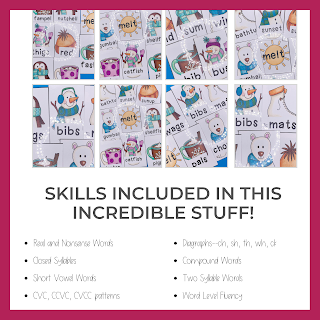
ROAR–CVC, CCVC, CVCC is built using pictures to support the words from Smarty Symbols but you also get cards with no pictures.
You can play with just CVC or CVCC with and without pictures.
.png)
OR
When I have a group working on Five and Six sounds. I pull out Melt. Then students can work on real and nonsense words. You can add easier words to build fluency or a couple of compound words to make it more interesting.
OR
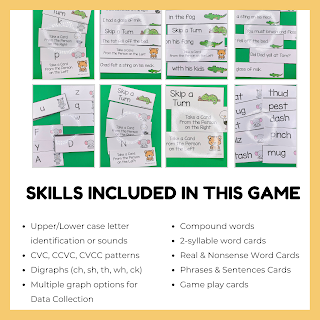
Click on any picture to check them out for yourself. Your students will love any of them.
What games do your students like to play?
Chat soon,

Feeling unsure about a student's phonics level? This new resource will instantly help
Have you ever sat in a meeting reviewing phonics data and someone asks if the student has mastered reading digraphs because the student doesn't demonstrate this in their small group?
Whether in an RTI meeting or just reviewing the data, this information helps plan the student's specific next steps.
If your phonics program is like mine--it didn't come with a quick way to progress monitor a student after you have taught a sound (phonogram). And sometimes you need more than dictation and how they read in the last decodable text.
You need more than a gut check BUT you need a number to prove what the student knows.
This Progress Monitoring Tools for Phonics solves this problem. It's quick and super easy to give after you have taught a sound. You can learn if students can read the phonogram at the word level (real & nonsense), sentence level, or in a paragraph with controlled text.
I use this Phonics Tool as a pre/post with mixed sounds. This has a very specific set of sounds such as all short, all R-controlled or all digraphs. Then I can teach the sounds in the pattern, reassess and have the data to prove if they have it or not.
The teacher's copy of the tool is colored-coded to make it super easy to score and make decisions about what to do next. This progress monitoring tool can be completed by teachers, para-professionals, or volunteers.
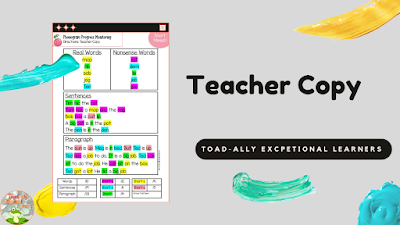
These sheets can be completed are perfect for small targeted groups and are a perfect addition to any Orton-Gillingham Practice or Phonics Intervention.
You can expect updates throughout the year including Vowel teams, Suffixes, -ng & -nk, and more!!
Grab your today before the price increases!
Chat Soon,

POW: Readers Needing More Support--Adapted Books with High Frequency Words
How do I get my readers more exposure to high-frequency or Red Words???
ADAPTED BOOKS
I love adapted books. My students LOVE them too! They are one of my favorite tools in my classroom. When it comes to building language skills or more experience with text--adapted books are a great way to effectively target specific skills in a way that is engaging for students.
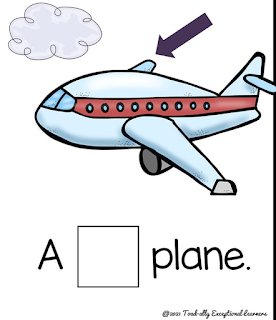
What is an Adapted Book?
Adapted books are books that have been modified in some way and often make it easier for students with disabilities to use but I also find adapted books are more engaging for all students to read and target so many critical language skills. I create and use adapted books all the time because they are interactive, motivating, and target various language skills. Many allow the students to feel successful and part of the book because they have to add or move pieces within the book.
Why You Need Adapted Books?
Research tells us kids with severe and profound disabilities often get sub-par literacy instruction. Part of that is based on people’s assumptions about the abilities of students with complex disabilities, the idea that instructional materials should only focus on functional or sight word instruction, and fact that language skills are generally lacking for students in this population. The other part of that is a feeling that instructional materials are just not made for these students in a way that is accessible.
There are a couple of big targets you are trying to hit when you add adapted books or novels to your classroom and lessons. One of them is to increase a student’s access to literature. You would be amazed at how many classrooms have NO appropriate reading materials in their classrooms. Because our students take longer to learn new skills, available literature tends to be juvenile or fully functional.
It is imperative students with severe disabilities are exposed to developed ideas and advanced concepts as a means of improving overall literacy and adapted books are the perfect vehicle to do that.
Adapted books can vary in skill level and be used for a wide variety of students with different skill sets and literacy skills. Many times there are pictures associated with the vocabulary terms so it provides those extra visual supports to help with understanding and comprehension of the verbal message. As the books become more challenging students rely less on pictures and more on written words.
What is a High-Frequency Adapted Book?
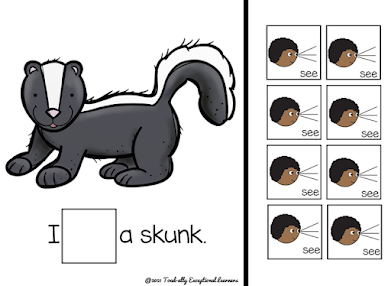
Predictable texts are a specific type of book used in the earliest stages of reading instruction. It provides students with more frequent exposure to the targeted word. The texts have a repeated sentence or phrase on each page, typically with one variable word. A picture accompanies each sentence that allows the student to guess the variable word using the picture.
Errorless teaching is an instructional strategy that ensures children always respond correctly. Each page has only one answer--the target word. This means students are getting more frequent correct exposure to the word than reading authentic text where they can guess at the word.
Why Have Visuals Tied to Text?
Visuals are consistent. Visuals allow time for language processing. Visual prompts can offer a visual image and written word to meet the needs of a variety of students’ abilities. Visuals help students see what a word means. Visuals help to build independence.
So What Should I Do?
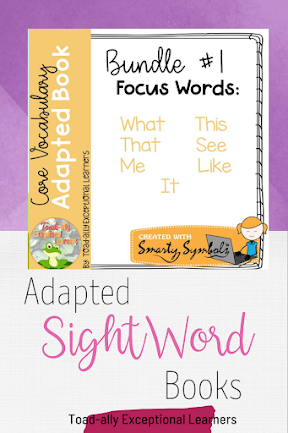
The first thing you should do is get this FREE adapted book by clicking here! Yeah. I love my readers… a lot. This is a very simple book.
Are you wanting more???? This bundle has 7 more to help you build your student's high-frequency reading knowledge.
Chat Soon-

PS--Bundle 2 coming soon
3 Fan Favoriate Phonemic Awareness Ideas (that are free)

What is Phonemic Awareness?

Phonemic Awareness (PA) is:
- the ability to hear and manipulate the sounds in spoken words and the understanding that spoken words and syllables are made up of sequences of speech sounds
- essential to learning to read in an alphabetic writing system, because letters represent sounds or phonemes. Without phonemic awareness, phonics makes little sense
- fundamental to mapping speech to print. If a child cannot hear that "man" and "moon" begin with the same sound or cannot blend the sounds /rrrrrruuuuuunnnnn/ into the word "run", he or she may have great difficulty connecting sounds with their written symbols or blending sounds to make a word
- essential to learning to read in an alphabetic writing system
- a strong predictor of children who experience early reading success
Why is it important?
- It requires readers to notice how letters represent sounds. It primes readers for print
- It gives readers a way to approach sounding out and reading new words
- It helps readers understand the alphabetic principle (that the letters in words are systematically represented by sounds)
...but difficult:
- Although there are 26 letters in the English language, there are approximately 40 phonemes, or sound units, in the English language
- Sounds are represented in 250 different spellings (e.g., /f/ as in ph, f, gh, ff)
- The sound units (phonemes) are not inherently obvious and must be taught. The sounds that make up words are "coarticulated;" that is, they are not distinctly separate from each other
What Does the Lack of Phonemic Awareness Look Like?
Children lacking phonemic awareness skills cannot:
- group words with similar and dissimilar sounds (mat, mug, sun)
- blend and split syllables (f oot)
- blend sounds into words (m_a_n)
- segment a word as a sequence of sounds (e.g., fish is made up of three phonemes, /f/ , /i/, /sh/)
- detect and manipulate sounds within words (change r in run to s)

Evidence Based Practices and the Big 5

Evidence-based practices in education are the same. They are backed by rigorous, high-standard research, replicated with positive outcomes, and backed by their effects on student outcomes. EBPs take the guesswork out of teaching by providing specific approaches and programs that improve student performance. There is frustration in teaching when you cannot find a way to help your student learn. You try one thing and then another and another and they are not having positive outcomes for your student. EBPs have proven outcomes on students’ performance and can make finding and implementing an effective practice less frustrating.
Using evidence-based practices (EBPs), with special education students especially, is a critical feature of improving their learning outcomes. When teachers combine their expertise as content knowledge experts with explicit instruction and practices and programs backed by research, the likelihood that a child will grow academically is increased.
A quick history lesson
We all love or hate the Big 5.
BUT..... without them
Congress appointed a National Reading Panel (NPR) in 1997 to review reading research and determine the most effective methods for teaching reading. The NRP reviewed over 100,000 studies and analyzed them to see what techniques actually worked in teaching children to read. The group only looked at quantitative studies, which gathered data in a numerical form and through structured techniques. Qualitative studies, which gather data through observations such as interviews were not included. In 2000 the NRP submitted their final report. The results became the basis of the federal literacy policy at that time, which included “No Child Left Behind.” We still base our understanding of evidence-based reading research on the NPR, but sadly, some of their major recommendations have been largely ignored. So what were their findings? They concluded that there were five essential components to reading, known as “The Big Five:”
- Explicit instruction in Phonemic Awareness.
- Systematic Phonics Instruction.
- Techniques to improve Fluency. These include guided oral reading practices where the student reads aloud and the teacher makes corrections when the student mispronounces a word. A teacher can also model fluent reading to the student. Fluency includes accuracy, speed, understanding, and prosody. Word calling is not the same as fluency.
- Teaching vocabulary words or Vocabulary Development.
- Reading Comprehension.
On top of this comes systematic Phonics. Children learn that the sounds in spoken words relate to the patterns of letters in written words. Not just mastery of the skills of systematic phonics, but automaticity in those skills, is also necessary for fluency to develop.
With these two layers in place and developed to the point of automaticity, techniques to improve Fluency can begin to be effective.
Vocabulary Development can be built next, including learning the meaning of new words through direct and indirect instruction, and developing tools like morphemic analysis, to discover the meaning of an unknown word.
Then Comprehension Skills can be added. Comprehension skills are the strategies a reader can use to better comprehend a text.
This is the foundation of reading, but it is also the foundation of education generally. Every subject is dependent on reading, and mastery of these subjects depends on developing a strong foundation in these early literacy skills.
As I continue to explore Evidenced-Based Practices, I will use the “Big 5” to share how they can be developed, and provide some resources that you can take back and use.
Chat Soon,

Evidence Based or Best Practice: The Beginning
Balanced literacy. Orton-Gilliamham. Think-Alouds. Graphic Organizers. Direct instruction. OMG!!!
Have you ever sat staring at your plans and IEPs and wonder how the #@& am I going to move this kid? Simply because of where the student sits in relation to their grade-level peers.
I have.
OR
I have so many with the same need but they didn’t make as much progress as I was hoping. (Or they needed to.)
Buildings don’t buy curriculum programs with special education students in mind. They might ask (if you're lucky) for your input. To be real, they buy with the larger in mind, which makes sense when you need to get the biggest bang for your buck.
What to do?????
In my building, moving students more than a year's growth is VERY important to us. We strive to close those gaps before they move to middle school.
I don’t have programs. Well, I have access to several but they can be (and most of the time) used by classroom teachers or worse the materials from the program were used but not the program itself.
I know I’m not the only one. So, what do you do???
OR
Want to learn what I do to get data that looks like this?


I had an Instructional Coach when I first started teaching, that showed me the value of putting time into learning and mastering both educational best practices and evidence-based practices. So even, if I was stuck with limited options, I could get tons of bang without a whole lot of stress.
Take guided reading, (yes, I know but you have to work with what you got), I became an expert at guided reading. I worked in tiny groups of two and three but with best practices and a couple of evidence-based practices, I was able to move kids to within months of their peers. (This brings up a whole different conversation when you can do this--is core really happening in the classroom or are they special education. I’m not going to answer those questions, as those are part of the larger school system.)

and

David Ardale defines best education practices as the wide range of individual activities, policies, and program approaches to achieving positive changes in student attitudes or academic behaviors.
Think Hattie and Marzano. (We all have a love/hate relationship with them)
Join me as I walk through how I use these ideas to get the most bang for your buck and move kids to close gaps with my special education students.

Send me your questions or if you're stuck and need help with. I’ll help you problem solve.
Chat soon,





I contribute to:


