POW: Readers Needing More Support--Adapted Books with High Frequency Words
How do I get my readers more exposure to high-frequency or Red Words???
ADAPTED BOOKS
I love adapted books. My students LOVE them too! They are one of my favorite tools in my classroom. When it comes to building language skills or more experience with text--adapted books are a great way to effectively target specific skills in a way that is engaging for students.
What is an Adapted Book?
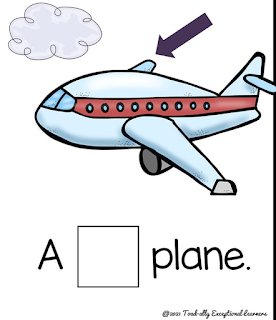
Adapted books are books that have been modified in some way and often make it easier for students with disabilities to use but I also find adapted books are more engaging for all students to read and target so many critical language skills. I create and use adapted books all the time because they are interactive, motivating, and target various language skills. Many allow the students to feel successful and part of the book because they have to add or move pieces within the book.
Why You Need Adapted Books?
Research tells us kids with severe and profound disabilities often get sub-par literacy instruction. Part of that is based on people’s assumptions about the abilities of students with complex disabilities, the idea that instructional materials should only focus on functional or sight word instruction, and fact that language skills are generally lacking for students in this population. The other part of that is a feeling that instructional materials are just not made for these students in a way that is accessible.
There are a couple of big targets you are trying to hit when you add adapted books or novels to your classroom and lessons. One of them is to increase a student’s access to literature. You would be amazed at how many classrooms have NO appropriate reading materials in their classrooms. Because our students take longer to learn new skills, available literature tends to be juvenile or fully functional.
It is imperative students with severe disabilities are exposed to developed ideas and advanced concepts as a means of improving overall literacy and adapted books are the perfect vehicle to do that.
Adapted books can vary in skill level and be used for a wide variety of students with different skill sets and literacy skills. Many times there are pictures associated with the vocabulary terms so it provides those extra visual supports to help with understanding and comprehension of the verbal message. As the books become more challenging students rely less on pictures and more on written words.
What is a High-Frequency Adapted Book?
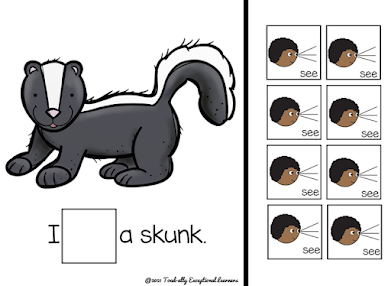
Predictable texts are a specific type of book used in the earliest stages of reading instruction. It provides students with more frequent exposure to the targeted word. The texts have a repeated sentence or phrase on each page, typically with one variable word. A picture accompanies each sentence that allows the student to guess the variable word using the picture.
Errorless teaching is an instructional strategy that ensures children always respond correctly. Each page has only one answer--the target word. This means students are getting more frequent correct exposure to the word than reading authentic text where they can guess at the word.
Why Have Visuals Tied to Text?
Visuals are consistent. Visuals allow time for language processing. Visual prompts can offer a visual image and written word to meet the needs of a variety of students’ abilities. Visuals help students see what a word means. Visuals help to build independence.
So What Should I Do?
The first thing you should do is get this FREE adapted book by clicking here! Yeah. I love my readers… a lot. This is a very simple book.
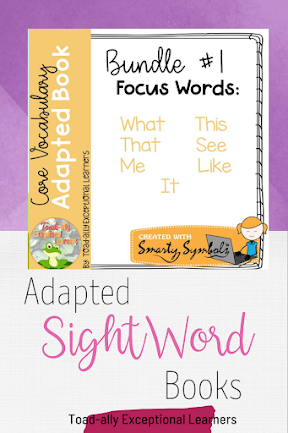
Are you wanting more???? This bundle has 7 more to help you build your student's high-frequency reading knowledge.
Chat Soon-

PS--Bundle 2 coming soon
3 Fan Favoriate Phonemic Awareness Ideas (that are free)

What is Phonemic Awareness?

Phonemic Awareness (PA) is:
- the ability to hear and manipulate the sounds in spoken words and the understanding that spoken words and syllables are made up of sequences of speech sounds
- essential to learning to read in an alphabetic writing system, because letters represent sounds or phonemes. Without phonemic awareness, phonics makes little sense
- fundamental to mapping speech to print. If a child cannot hear that "man" and "moon" begin with the same sound or cannot blend the sounds /rrrrrruuuuuunnnnn/ into the word "run", he or she may have great difficulty connecting sounds with their written symbols or blending sounds to make a word
- essential to learning to read in an alphabetic writing system
- a strong predictor of children who experience early reading success
Why is it important?
- It requires readers to notice how letters represent sounds. It primes readers for print
- It gives readers a way to approach sounding out and reading new words
- It helps readers understand the alphabetic principle (that the letters in words are systematically represented by sounds)
...but difficult:
- Although there are 26 letters in the English language, there are approximately 40 phonemes, or sound units, in the English language
- Sounds are represented in 250 different spellings (e.g., /f/ as in ph, f, gh, ff)
- The sound units (phonemes) are not inherently obvious and must be taught. The sounds that make up words are "coarticulated;" that is, they are not distinctly separate from each other
What Does the Lack of Phonemic Awareness Look Like?
Children lacking phonemic awareness skills cannot:
- group words with similar and dissimilar sounds (mat, mug, sun)
- blend and split syllables (f oot)
- blend sounds into words (m_a_n)
- segment a word as a sequence of sounds (e.g., fish is made up of three phonemes, /f/ , /i/, /sh/)
- detect and manipulate sounds within words (change r in run to s)

Evidence Based Practices and the Big 5

Evidence-based practices in education are the same. They are backed by rigorous, high-standard research, replicated with positive outcomes, and backed by their effects on student outcomes. EBPs take the guesswork out of teaching by providing specific approaches and programs that improve student performance. There is frustration in teaching when you cannot find a way to help your student learn. You try one thing and then another and another and they are not having positive outcomes for your student. EBPs have proven outcomes on students’ performance and can make finding and implementing an effective practice less frustrating.
Using evidence-based practices (EBPs), with special education students especially, is a critical feature of improving their learning outcomes. When teachers combine their expertise as content knowledge experts with explicit instruction and practices and programs backed by research, the likelihood that a child will grow academically is increased.
A quick history lesson
We all love or hate the Big 5.
BUT..... without them
Congress appointed a National Reading Panel (NPR) in 1997 to review reading research and determine the most effective methods for teaching reading. The NRP reviewed over 100,000 studies and analyzed them to see what techniques actually worked in teaching children to read. The group only looked at quantitative studies, which gathered data in a numerical form and through structured techniques. Qualitative studies, which gather data through observations such as interviews were not included. In 2000 the NRP submitted their final report. The results became the basis of the federal literacy policy at that time, which included “No Child Left Behind.” We still base our understanding of evidence-based reading research on the NPR, but sadly, some of their major recommendations have been largely ignored. So what were their findings? They concluded that there were five essential components to reading, known as “The Big Five:”
- Explicit instruction in Phonemic Awareness.
- Systematic Phonics Instruction.
- Techniques to improve Fluency. These include guided oral reading practices where the student reads aloud and the teacher makes corrections when the student mispronounces a word. A teacher can also model fluent reading to the student. Fluency includes accuracy, speed, understanding, and prosody. Word calling is not the same as fluency.
- Teaching vocabulary words or Vocabulary Development.
- Reading Comprehension.
On top of this comes systematic Phonics. Children learn that the sounds in spoken words relate to the patterns of letters in written words. Not just mastery of the skills of systematic phonics, but automaticity in those skills, is also necessary for fluency to develop.
With these two layers in place and developed to the point of automaticity, techniques to improve Fluency can begin to be effective.
Vocabulary Development can be built next, including learning the meaning of new words through direct and indirect instruction, and developing tools like morphemic analysis, to discover the meaning of an unknown word.
Then Comprehension Skills can be added. Comprehension skills are the strategies a reader can use to better comprehend a text.
This is the foundation of reading, but it is also the foundation of education generally. Every subject is dependent on reading, and mastery of these subjects depends on developing a strong foundation in these early literacy skills.
As I continue to explore Evidenced-Based Practices, I will use the “Big 5” to share how they can be developed, and provide some resources that you can take back and use.
Chat Soon,

Evidence Based or Best Practice: The Beginning
Balanced literacy. Orton-Gilliamham. Think-Alouds. Graphic Organizers. Direct instruction. OMG!!!
Have you ever sat staring at your plans and IEPs and wonder how the #@& am I going to move this kid? Simply because of where the student sits in relation to their grade-level peers.
I have.
OR
I have so many with the same need but they didn’t make as much progress as I was hoping. (Or they needed to.)
Buildings don’t buy curriculum programs with special education students in mind. They might ask (if you're lucky) for your input. To be real, they buy with the larger in mind, which makes sense when you need to get the biggest bang for your buck.
What to do?????
In my building, moving students more than a year's growth is VERY important to us. We strive to close those gaps before they move to middle school.
I don’t have programs. Well, I have access to several but they can be (and most of the time) used by classroom teachers or worse the materials from the program were used but not the program itself.
I know I’m not the only one. So, what do you do???
OR
Want to learn what I do to get data that looks like this?


I had an Instructional Coach when I first started teaching, that showed me the value of putting time into learning and mastering both educational best practices and evidence-based practices. So even, if I was stuck with limited options, I could get tons of bang without a whole lot of stress.
Take guided reading, (yes, I know but you have to work with what you got), I became an expert at guided reading. I worked in tiny groups of two and three but with best practices and a couple of evidence-based practices, I was able to move kids to within months of their peers. (This brings up a whole different conversation when you can do this--is core really happening in the classroom or are they special education. I’m not going to answer those questions, as those are part of the larger school system.)

and

David Ardale defines best education practices as the wide range of individual activities, policies, and program approaches to achieving positive changes in student attitudes or academic behaviors.
Think Hattie and Marzano. (We all have a love/hate relationship with them)
Join me as I walk through how I use these ideas to get the most bang for your buck and move kids to close gaps with my special education students.

Send me your questions or if you're stuck and need help with. I’ll help you problem solve.
Chat soon,

Wait...Orton...What????
I came across Orton-Gillingham during a field placement as an undergrad. The special education teacher was using Wilson with her small groups to help them build reading skills. Mind you--this was not something taught in my program but she opened my eyes to something I would keep in my teaching bag.
The Orton-Gillingham approach is a multi-sensory way of teaching reading, spelling, and writing skills to students who struggle with language-based learning difficulties, including dyslexia. Lessons focus on mastery of the smallest units of language first, including phonemes and graphemes, and then build to whole word, phrase and sentence level instruction.
Important to note: Orton-Gillingham refers to an instructional approach, not any particular program or curriculum.
A Quick History Lesson
The term “dyslexia” first appeared in texts in the early 1870s. The Orton-Gillingham approach has been in use for the past 80 years and is the oldest dyslexia-specific approach to remedial reading instruction. It was developed in the 1930s by neuro-psychiatrist Dr. Samuel Orton based on his work with children who struggled with language processing issues but were of normal intelligence.
Dr. Orton proposed a neurological basis for the problem and developed a series of activities that combined right and left brain functions, predicting it would positively impact the ability to read and spell.
Dr. Anna Gillingham focused her efforts on training teachers in the approach, creating materials and expanding the instruction to include essential features of the English language, such as prefixes, suffixes, and even spelling rules.
Encouraged by Dr. Orton, she compiled and published instructional materials as early as the 1930s which provided the foundation for student instruction and teacher training. This collaboration became known as the Orton-Gillingham Approach.

What is Orton Gillingham?
This is where there seems to be a communication gap between parents and schools. OG is not a program, course or curriculum. There is no official “Orton Gillingham certification” for teachers. Your child does not get pulled out of their classroom an hour a day and taken someplace else to learn OG.
So what is OG then? First, it’s usually called the Orton Gillingham Approach.
And that’s what it is–an approach or way of teaching.
Orton-Gillingham places an important emphasis on multi-sensory approaches to learning. But it is more than that.
Orton-Gillingham is a highly structured approach, that breaks down reading and spelling into letters and sounds, and then building on these skills over time. OG was the first approach to use multi-sensory teaching strategies to teach reading.
This means that educators use sight, sound, touch, and motor movement to help students connect and learn the concepts being taught.
This multi-sensory approach helps students understand the relationship between letters, sounds, and words.
For example, an OG teacher a student to learn a letter by:
- seeing it
- saying it out loud
- sounding it out
- singing it
- writing it with pen or pencil
- writing it with fingers in shaving cream or sand
- forming it with clay or play-doh
- making the letter with your body or blocks
What is dyslexia?
Dyslexia is the most commonly diagnosed reading disorder. Dyslexia is also found on a continuum of severity, ranging from mild characteristics of dyslexia to profound difficulty with reading and writing. In its most severe forms, it is a learning disability. In its mildest form, it may be a source of puzzlement, frustration or mild inconvenience.
Dyslexia is a specific learning disability that is neurobiological in origin. It is characterized by difficulties with accurate and/or fluent word recognition and by poor spelling and decoding abilities.
As a result of this span of difficulty, the exact prevalence of dyslexia has yet to be definitively determined. It has been suggested that perhaps as many as 15% to 20% of the population as a whole have some of the symptoms of dyslexia (IDA, 2017).
Orton-Gillingham works because it enhances phonemic awareness in dyslexic individuals by examining common language patterns. Learners experiment with blending sounds, looking at letters and word parts in isolation and in various configurations, and studying language features, including diphthongs and silent letters.
The goal of Orton-Gillingham based instruction is to enable learners to decode words on their own and improve literacy skills in order to achieve their full potential at school.
Every state has its own special education legislation for the identification and special education support for students with a specific learning disability.
In Colorado, during the special education evaluation process, the team must document any characteristics of dyslexia. Be sure to look at your Department of Education--Special Education for what the team must do.
What the Orton-Gillingham Approach Can Teach Reading
The OG Approach can teach:
- Decoding: break words into their syllables and phonemes (the smallest unit of sound) to be able to read the word. Develops automaticity and fluency at the word level.
- Encoding: break down words orally into their syllables and phonemes to be able to spell the word.
However, an OG program requires supplemental programming to teach fluency and composition.
Can a Parent Teach Orton Gillingham?
Well, in the loosest form of OG, anyone can teach OG. All you need is a multi-sensory approach and you can say you’re OG. But just like too many behaviorists say they are using ABA (when they’re really not), OG is not for everyone either. This is where you have to be careful.
I’m not a BCBA, but I can reinforce ABA principles and activities at home with my son. I would say for most parents, you can reinforce tasks and lessons from school or at private tutoring. But unless you are a teacher or reading specialist, I would leave it to the experts.
Getting Orton Gillingham on your IEP
Want OG added to your IEP??? Ask the Team.
Ok, here’s where the troubles are, right? You asked for OG on your IEP, because it helps kids with dyslexia learn to read.
They said no. Ask for the progress monitoring data. So, what about trialing a change and getting back together in 30 days with data?
Have data??
Questions to ask:
- What is the data looking at? spelling (Encoding), reading (decoding)
- Is there improvement? How big?
- Ask the classroom teacher, what do they see?
- Ask the team, who is trained in which program? (Programs Accredited by IDA)
Fact is, many reading programs designed for students with dyslexia are based on the Orton Gillingham Approach. But the OG approach alone may not be enough to get them there.
Learning OG has been a wonderful and overwhelming journey but I have had students who are very successful with this approach and others who need a different approach to help them learn to read. It always comes back to the data.
Parents, always ask for it if the team doesn't bring it! Don't be afraid to push back on the team if they don't have it and ask questions about it and what it means for your child.
Chat soon,




I contribute to:


